
“Pressure washing” has become the catch-all name for cleaning anything on the outside of a house. But the force that strips years of grime from a concrete driveway can damage vinyl siding, peel paint, gouge wood and shorten the life of a roof. The right method depends on the surface you’re cleaning.
Here’s how traditional pressure washing and low-pressure house washing differ, which surfaces need which approach, and how to keep your home’s exterior clean without causing problems you’ll pay for later.
The short answer
- Hard, durable surfaces like concrete driveways and sidewalks can handle higher pressure.
- Siding, painted surfaces and roofs should be cleaned with low pressure and a cleaning solution that does the work.
- Wood decks and fences need a careful, controlled approach somewhere in between.
What’s the difference?
Pressure washing: the force of the water does the work
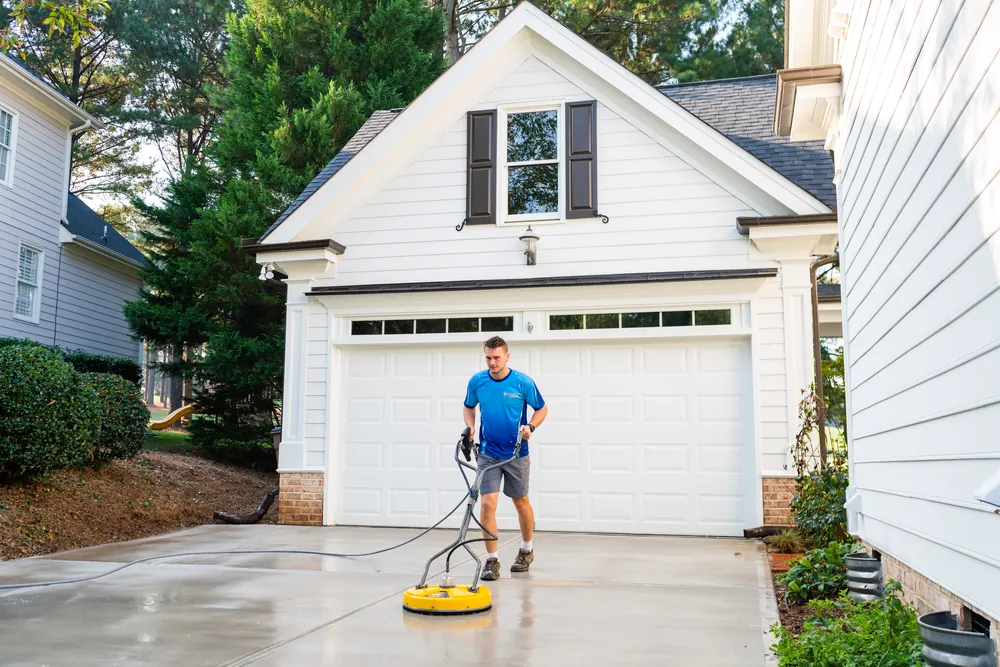
Traditional pressure washing relies on force. A machine pressurizes the water, and a narrow spray blasts dirt, grime and loose material off the surface. It’s fast and effective on hard, durable surfaces like concrete, where there’s little risk of damage and stubborn dirt needs the extra muscle. On flat areas like driveways and patios, professionals often use a rotary surface cleaner, which spins the spray under a round hood for an even clean without the stripes a wand can leave.
House washing: the cleaning solution does the work
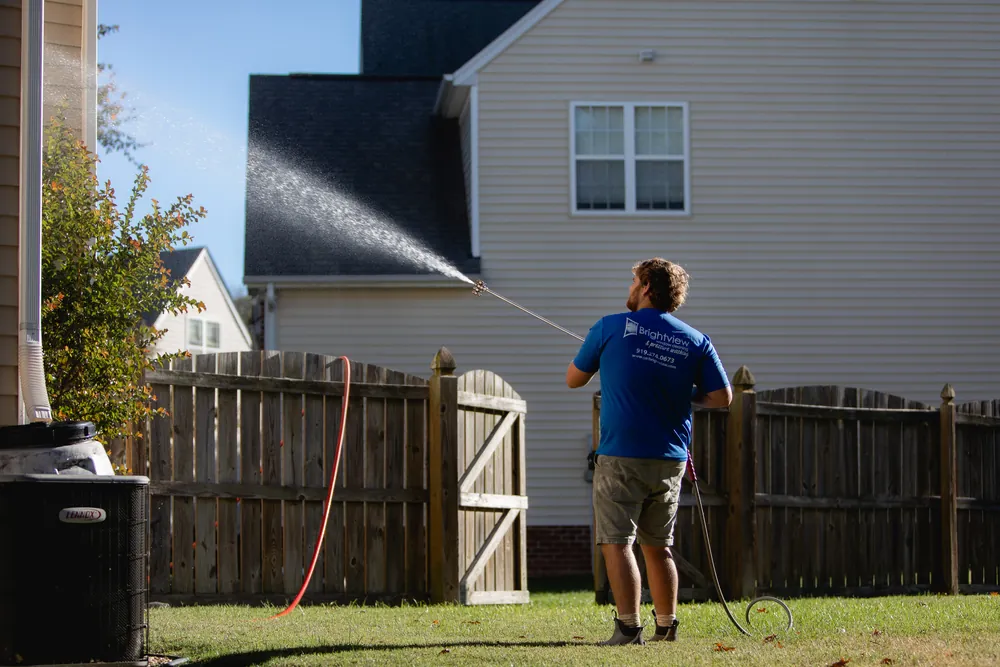
House washing takes the opposite approach. Instead of relying on force, a low-pressure system applies a cleaning solution that breaks down dirt, mold, mildew and algae, then rinses it away gently. Because the solution does the heavy lifting, there’s far less risk of forcing water where it doesn’t belong or damaging the surface. This is how Brightview cleans homes: with a low-pressure house wash system that removes mold, mildew, algae and dirt without damaging siding.
Which method does each surface need?
| Surface | Best approach | Why it matters |
|---|---|---|
| Vinyl siding | Low pressure with a cleaning solution | High pressure can force water behind the panels |
| Painted wood and fiber cement | Low pressure | Too much force can strip paint and mark the surface |
| Brick and stone | Low to moderate pressure | Protects mortar joints and softer brick faces |
| Roof shingles | Low pressure only | High pressure can strip the protective granules |
| Concrete driveways, sidewalks and patios | Higher pressure, often with a surface cleaner | Lifts embedded dirt evenly, without stripes |
| Wood decks and fences | Controlled, moderate pressure | Too much force raises fibers and gouges the wood |
Every home is a little different, so a good professional looks at the materials, their age and their condition before deciding how to clean them.
How too much pressure damages a home
High-pressure water is powerful enough to cut into wood. Pointed at the wrong surface, it can cause damage that isn’t always obvious right away:
- Water behind vinyl siding. Siding is designed to shed rain falling from above, not water sprayed up from below. Forcing water behind the panels can soak the wall underneath and lead to mold or rot.
- Peeling paint and marked surfaces. A narrow, high-pressure spray can lift paint and leave visible lines in softer materials.
- Eroded mortar. Older mortar joints can wear away under direct, concentrated spray.
- Leaks around windows and doors. Spraying straight at window seals and door frames can push water past them and into the house.
- A shorter roof life. Shingles rely on their granules for protection, and blasting them off ages a roof early.
- Trouble in the flower beds. Spray and runoff need to be managed carefully around plants and landscaping.
What’s really on your siding?
Much of the discoloration on homes in our area isn’t just dirt. North Carolina’s warm, humid summers are ideal for organic growth, and the Triangle’s shade trees keep many walls damp for hours after a rain.
- Green algae often shows up on the north side of a house and on shaded walls.
- Mildew and mold appear as gray or black specks, especially under the eaves and around trim.
- Pollen coats every surface each spring and settles into textured siding.
- Red clay splashes up along the foundation during heavy rains. It’s an inorganic stain, so removing it isn’t part of a standard wash, but it can be treated for an additional charge.
- Black streaks on gutter faces, often called “tiger stripes,” are bonded to the surface and won’t come off with a standard house wash.
- Chalky, faded patches on the sunny side of a house are usually oxidation of the siding or paint, which washing can’t reverse and can even make more noticeable.
Algae and mildew are living growth, so scrubbing or blasting only removes what you can see on the surface. A cleaning solution breaks the growth down so it rinses away, which is one more reason low-pressure washing is the better fit for siding. Knowing what’s organic and what isn’t also helps you set the right expectations before the work starts.
Roofs need the right method and the right weather
Dark streaks running down a roof are usually caused by algae rather than dirt, and they’re common on shingle roofs in humid climates. Roofs should never be cleaned with high pressure, because the force can strip the granules that protect shingles from sun and weather.
Weather matters too. Brightview schedules roof washing when temperatures are above 80°F with light or no wind, so in our area it’s a warm-season service. If your roof needs attention, ask about timing when you request a quote.
Driveways, sidewalks and patios
Concrete is where higher pressure earns its keep. Over time, driveways and walkways collect dirt, mildew, leaf stains and tire marks that settle into the surface. A surface cleaner lifts that grime evenly across large flat areas, and a wand handles the edges, steps and corners.
It helps to set realistic expectations. Brightview’s standard pressure washing doesn’t include removing inorganic stains like red clay, rust or oil, though those treatments are available for an additional charge. Washing can also lighten unsealed or weathered surfaces. If there’s a stain you’re worried about, mention it when you request your quote.
Decks and fences
Wood is softer than it looks. Too much pressure raises the grain, leaves fuzzy fibers on the surface and can carve lines into the boards. The goal with decks and fences is to remove mildew, algae and weathered gray dirt with a controlled approach, which helps protect the wood from rot, decay and premature aging. If you plan to stain or seal your deck, cleaning it first helps the finish go on evenly; check the stain manufacturer’s instructions for how long the wood should dry beforehand.
How often should you wash your home’s exterior?
- Siding: about once a year for most homes, and more often for shaded homes or walls that stay damp.
- Driveways, sidewalks and patios: once a year, or whenever stains and mildew start to build up.
- Decks and fences: once a year, and before staining or sealing.
- Roofs: when dark streaks or growth appear, during warm weather.
Many homeowners wash in the spring, after pollen season, or in the fall, before the holidays and before the coldest part of winter. Our fall home exterior checklist shows how washing fits in with gutters, windows and other seasonal jobs. If you’re cleaning the windows too, wash the house first; our guide to professional window cleaning explains what’s included.
The risks of renting a pressure washer
Rental pressure washers make the job look simple, but much of the damage described above comes from too much pressure and too little experience. A pressure washer can also cause serious injuries, and using one from a ladder to reach second-story siding adds the risk of a fall.
If you tackle a small job yourself, start with the lowest pressure setting and a wide-angle tip, keep the nozzle moving and well back from the surface, never spray upward under siding laps or straight at windows, and leave roofs and upper stories to a professional.
What to expect when Brightview washes your home
Here’s how a typical house wash or pressure washing visit works:
- Free quote. Tell us what you’d like cleaned, whether that’s siding, a roof, a driveway, a deck or all of the above. Request an estimate online or call the office.
- Prep instructions. Two days before service, you’ll get an email or text with a short checklist.
- Getting ready. Close all windows and doors. Move cushions, rugs, decorations and potted plants you don’t want to get wet, move vehicles away from the areas being cleaned, and unlock gates and screened porches. The crew moves or covers large items like grills and furniture. If they have to move the smaller items, a $50 fee is added.
- Service day. The crew connects to your outdoor water and cleans each surface with the right method. You don’t need to be home.
- Payment. Pay the crew by cash, check or card if you’re home. Otherwise, the office emails an invoice you can pay by card through a link or by mailing a check.
One more detail: the crew connects to your on-site water source, and a minimum $150 fee applies if you’d prefer we not use it. Full details are on our How to prepare page and in our FAQ.
“… yesterday I had them power wash my house and concrete surfaces. My home just sparkles now! Jacob and David did an outstanding job.”
Lauren Dove, house and concrete washing customer
Frequently asked questions
Is pressure washing safe for vinyl siding?
Yes, when it’s done with the right method. Brightview washes homes with a low-pressure house wash system that removes mold, mildew, algae and dirt without damaging siding.
Do I need to be home?
No. Just unlock gates and screened porches so the crew can reach every area.
Do I need to close my windows?
Yes. Before service, make sure all windows, doors and other openings are fully closed so water can’t get inside.
Is there a minimum charge?
Yes. There is a $175 minimum for pressure washing services.
Clean without the risk
The best exterior cleaning matches the method to the surface: gentle on siding and roofs, stronger where concrete can take it and careful everywhere in between. See everything we clean on our pressure washing page, request a free estimate or call or text (919) 274-0673. Brightview serves Wake Forest, North Raleigh, Raleigh, Rolesville, Youngsville, Franklinton, Knightdale, Wendell, Creedmoor, Durham, Chapel Hill, Cary, Morrisville and Clayton.

Brightview is a family-owned window cleaning, pressure washing and gutter cleaning company that has served Wake Forest, Raleigh and the Triangle since 2007. Meet the team.

